Archives for posts with tag: academics

This is a cautionary tale of curiosity gone awry.

If you’ve been following this , you know that I’m awaiting word on whether or not I have been accepted to a PhD program. To this date I’ve heard nothing. So, drawing a naive allusion to the famed cat, one might say that, as far as I know, I’m both accepted into and rejected from all of the programs. Seems simple enough.

Cornell Grad SchoolHowever, thanks to the marvels of modern technology and my own tinkering nature, I’m now even more confused about my quantum status at Cornell University.

You see, a few days ago, I paid a visit to the Cornell site to see if they had any more information up about dates. There was nothing there to speak of. So I did some poking around on the graduate admissions page. One of the links there is “Accept an Offer of Admission Online.” Being the positive (and impatient) thinker I am, I figured “what the heck, might as well see what’s there.” A click or so later, I find myself at Embark, Cornell’s online application tool. This password protected website is how I submitted my application in the first place. And it’s requesting that I log in.

So I faced a decision: do I log in and possibly find out my status? Or do I wait to see if I get a big envelope or a skinny envelope?

Curiosity (or perhaps temptation) got the best of me, I logged in, and was asked if I want to accept the offer to attend Cornell.

This discovery has launched me into a existential/systems dilemma. Had I just gotten notification that I’ve been accepted to Cornell? Was the system “smart” enough to have that record on hand? Or had it been designed with the fundamental assumption that only people who had been accepted would follow that link? Did the programmers not envision someone like me?

As much as I wish this was confirmation of an offer, I tend to think it’s probably a “dumb” system.[1] Considering that my notification note from Chicago was dated February 26th, there a good chance a final decision has yet to be made at any of the programs. And even if the decision has been made, typically computer systems are the last ones to know. But more than anything else, I don’t want to work myself up and then get crushed.

So, for the moment I remain both accepted into and rejected from all of the programs. Only I’m just a little more so at Cornell.

—-

[1] – The irony that, once again, I’m twisting on the end of questions about Machine Intelligence isn’t lost on me. Just as with my work on bots, the crux of all of this is a question of whether or not the machine knows as much as I give it credit for knowing. Oh well, while these systems may be toying with my emotions, at least I didn’t give my credit card out this time.
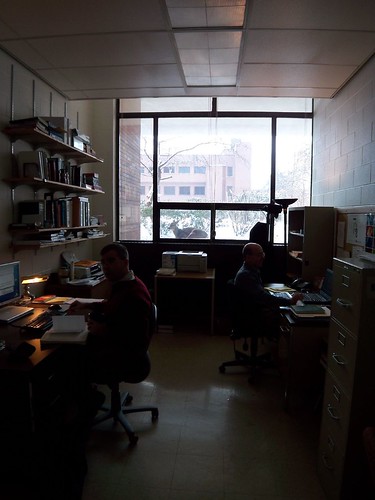

Notice anything funny outside the office window?

Notice anything out of the ordinary at the School for Print Media?

A deer decided to bed down today outside the office of Professor Williams and Vogl. We’re not quite sure how long it was there for. It must have felt the row of small hedges gave it some protection from the elements (and the students). As for us professors, clearly aren’t perceived as a threat by anything — my students could have told you that.

The deer outside my office at RIT

Deer at RIT Panorama

a tale of two candidate???s video distribution strategies, my post looking at the recent spate of online candidate videos, has circulated a bit on the fringes of the political blog and citizen journalism communities. The first person to comment on it was Brian Russell (Yesh.com), who noted that Ruby Sinreich (lotusmedia.org) first shared the article with him. In that article I had linked to a YouTube video that Brian and Ruby had created responding to Edward’s presidential announcement. A few days later, the Yesh article was picked up by A Blog Around the Clock, which it turn was mirrored on Science Blogs. Finally, Aldon Hynes of the Orient Lodge and Greater Democracy responded to the dialog in post entitled Hope is Presidential.

Simply observing the circulation of my text is a revealing experience (as is watching the flow of related traffic to that post, thank you Feedburner). It also has been reinforcing the things one must think about when they endeavour to begin online fieldwork, especially if one chooses to do so in a public manner. In a wonderful little essay Fire, Loss, and the Sorcerer’s Apprentice, Robart Sanjek, recounted the story about how the anthropologist Ethel Albert once discovered her Rwandan field assistant Muntu clandestinely interviewing one of Albert’s informants. When asked what he was doing, Muntu replied “Anthropological research, like you. But I know the language, so my research will be better than yours.”[1] Muntu made it clear that what he was recording was his research and he didn’t intend to share it. Of this incident Sanjek wrote:

[Muntu’s] challenge to Albert embodies the present reality of a world in which those whom anthropologists study, everywhere, can read (and write) fieldnotes, let along ethnography. (Sanjek, 1990: 39)

I’m hard pressed to think of an environment this is more true of than the blogosphere. I can’t conceive of conducting online research and not placing some of it into online notes (be they a blog or a wiki). And the moment that occurs, your notes no longer belong to just you. So these types of discussions and circulations become an important part of the fieldwork process. Especially considering that the entire relationship between researcher and informants (or whatever the going term is these days) is so odd. We’re all creating media artifacts and putting them out there for the world to discover, never quite sure of who is viewing what.

The points that Brian and Aldon raised were all good things for me to think about. One thing in particular was Aldon’s comment:

Sen. Edwards??? announcement video on YouTube was a step in the direction of recognizing the different language of online videos, but there is still much further to go. What are the popular online videos? Ask a Ninja, Hope is Emo, Lonelygirl115 and various coke and mentos videos come to mind. Perhaps the 2008 candidates can learn from these videos.

Edwards and Obama can duke it out to see who gets ???Hope is Presidential???. Sen. Clinton, after her webcasts might think about engaging the folks at Ask a Ninja to come up with Ask a Candidate. The lesser know candidates can struggle to see who will be the next Lonely Candidate 2008. The real question is whose videos will be the coke and mentos of the 2008 campaign season. I haven???t seen any like that yet.

Aldon mentions Ask a Ninja, Hope is Emo, and Lonelygirl15 as YouTube exemplars. I’m not quite sure what the candidates can learn from these content creators, as they all are essentially “old media” examples in the new media space. All of these are professionally produced (read as scripted, acted, filmed, and edited by professionals). Lonelygirl15 is an even stranger example to invoke in an essay about grassroots “politicing,” considering that at it’s core Lonelygirl15 was a “manipulation” – professionally produced content presenting itself as reality. That notion of “reality” is at the core of recent political and YouTube discussions. It leads us to these questions that pop up both in regards to candidate’s online presence and to the YouTube/LiveVideo conflict.

What is authenticity in this digital space (provided it’s any different than authenticity in the so-called real world). The negotitation of it, like fieldnotes, is something I’m going to be doing a lot of thinking on in the weeks, months, and years to come.

References:

Bernius, M. (2007) a tale of two candidate???s video distribution strategies
Hynes, A. (2007) Hope is Presidential
Russell, B. (2007) Analyzing Campaign Video Distro Strategies
Sanjek, R. (1990) “Fire, Loss, and the Sorcerer’s Apprentice” in Fieldnotes: The making of Anthropology. Cornell University Press. Ithica NY.

I just found out today that the Associated Press will be carrying blogger’s coverage of the Lewis “Scooter” Libby trial! Here are key excerpts from the press releaser

[The Associated Press] partners with Media Bloggers Association to put bloggers’ coverage of high-profile trial of former Cheney aide on more than 600 newspapers’ websites…. The U.S. District Court in Washington D.C. has provided the MBA with credentials for two media seats at the Libby trial, which started Jan. 16 with jury selection. With jury selection now completed, the trial began in earnest with opening arguments today. …The MBA, which has about 1,000 members, is covering the trial from the overflow Media Center, which is equipped with video, allowing viewing of the trial, and Wi-Fi (wireless internet access), allowing the MBA to wirelessly syndicate a real-time feed of blogger coverage of the Libby trial.

This is huge news on multiple counts, both in terms of citizen journalism and my own research.

I had been aware of the Media Bloggers Association for a little while, but they had dropped off my radar.  Especially since I wasn’t quite sure where to start in terms of my broader cj research. This group seems to provide a wonderful jumping off point.

In answer to the question “why all this musing on campaign videos?”, if all goes as planned, I start my PhD studies in the fall. Provided I go the anthro route, I’ll be looking at citizen journalism and American politics. Internet video broadly, and YouTube specifically, play an important role in that mix.

Honestly, the more I begin to explore YouTube, the more complicated things get. It’s a mish mash. And the threads that are emerging from it are so varied I’m not quite sure where to start. All of it complicates this question of what exactly a citizen journalist is. There’s a lot of citizen commentators and folks who post clips from news networks. And activists.

I’m just not quite sure about “journalists.”