Where I was not able to make the trek out to Vegas, (unlike the Kodak crew who kicked absolute ass!), Ihave been keeping close watch of all the publishing related news from the event for the Open Publishing Lab (a summary of CES news related to eReaders, Tablets, and publishing). Now that things have calmed down, the next question is, beyond all the hype, what does this all mean for the future? Over the next few days we’ll share our best guesses about how the technology on display will influence the future of publishing.
Here are some random thoughts (also available at the OPL site)
1. Despite lots of buzz, the age of eReaders will be short lived![[Skiff eReader]](http://farm3.static.flickr.com/2774/4256898344_dc580aab7c_o.jpg)
There’s no doubt that eReaders were one of the big technologies of the moment at CES (even NPR covered them!). The problem for the is that they are really just that: the (transitional) technology of this moment.
I believe that within the next two years, tablets and modular slate devices are poised to be even bigger. For example, based on feature set displayed at CES, beyond low price, successful eReaders will all need to have: touchscreen control (finger tips, not just stylus), color, ability to connect to stores. Interestingly, these are all the things that tablets and convertible netbooks also are featuring, at roughly the same price range as current (black and white) eReaders (often with less than stellar touch control) – anyone see a potential problem?
Also, take the fact that tablets/slates are multifunctional devices, versus eReaders that are primarily unifunctional. Finally, as will be discussed in a different post, the line between phone and tablet/slate is already starting to blur. Given that many of the tablet/slate devices shown at CES now feature telephony (see the discussion below), it’s not hard to imagine a world in which many of us carry a 7 inch phone/tablet. In that world, dedicated eReaders are a hard sell.
In fact, we could argue that a number of eReaders are already there. Take for example the Entourage Edge’s and the Spring Design Alex Reader. Both integrate LCD touchscreens whose function goes well beyond system/content navigation. Others, like the Notion Ink’s Adam (a prototype reader that all the tech blogs were blown away by), demonstrate display technologies that are intended to beyond the simple rendering text.
2. eReader strategies
Building on this assumption that, beyond certain vertical/niche markets, eReaders are not long for the world, there are two strategies that can be read from the eReaders at CES:
a. The short term play: technology/manufacturing wins
(Own the market through manufacturing)
The strategy of companies like iRiver, Hanvon, Jinke, Samsung, amoung others, is to cheaply build a better mousetrap and get it to market asap. My guess is that, like digital cameras, the magic price point is somewhere around $149. Currently none of the devices are making that price point, though we expect that by the second half of this year, with discounting and price adjustments, we’ll see the prices on a number of eReaders drop into that range (especially those without touch screens).
While eReaders remain “premium goods” there will most likely be two big differentiators. First is price (potentially setting up devices like the Edge and Alex readers to be big winners because of expanded feature set at same pricepoint). Second is availability, with a market this flooded, getting into physical retail (and in front of consumers) is going to be huge (that’s provided that retailers are willing to give up the floor space).
b. The long term is Content not Device
(Device independent content)
Readers like the Copia, Kindle, Nook, Que, and Skiff (the eReader pictured above), are tied into platform specific eCommerce/Content applications. In most of these cases the device is the “gateway drug,” build customer loyalty and libraries. The hope is to transcend (and transition) devices. Take, for example, Copia‘s focus on building a social reading experience that brings people back to their service.
![[Blio software]](http://farm3.static.flickr.com/2701/4256137667_92fc4ab1ae_m.jpg) Perhaps this can most clearly be seen in Skiff’s reader development kit (RDK) strategy. Skiff looks to try and flood the market by giving third parties the guts of their Reader, complete with it’s baked in UI. While this could lead to the manufacture of (cheap) eReaders that compete with their reader, Skiff is not only making money on the kit, but also knows that each of those new eReaders will be getting content through their eCom engine.
Perhaps this can most clearly be seen in Skiff’s reader development kit (RDK) strategy. Skiff looks to try and flood the market by giving third parties the guts of their Reader, complete with it’s baked in UI. While this could lead to the manufacture of (cheap) eReaders that compete with their reader, Skiff is not only making money on the kit, but also knows that each of those new eReaders will be getting content through their eCom engine.
Looking at things from the long term perspective, Ray Kurzweil’s Blio reading platform (pictured to the right) becomes even more of a competitor to these companies (essentially they’re trying this strategy without the reader). Living up to his futurist reputation, Kurzweil’s service seem to built for the tablet future versus the eReader present. The big questions are can it deliver on its promise of an enhanced reading experience across devices and is whether or not it’s hitting too soon.
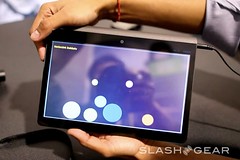 3. The short life of eInk and other B&W display technologies
Unless there are major improvements (color) or a step decline in cost of manufacture, eInk is not long for the world outside of certain niche markets. Provided that they can deliver on stable production models, there are a number of competing technologies that are poised to take over the display markets. On option is low voltage LCDs like the Liquid Vista’s display which promise to provide color content at a low power overhead.
Perhaps the most impressive technology is the hybrid Pixel Qi technology shown off on Notion’s Ink Adam prototype. Pixel Qi displays can function both as an LCD and as “eInk,” and according to their representative will be featured on a device from a major manufacturer later this year. In that last sentence, special emphasis is placed on “device” – the advantage of all of these technologies is that they can be used on a wide range of devices beyond eReaders. That potential reach has profound effects on the scope and scale of manufacturing, and therefore price. Without a major change, we don’t see eInk being able to compete on either experience or price.
4. Forget the Droid and NexusOne, the real story with Android is everything else it’s on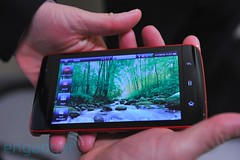
Google attempted to upstage CES with the announcement of the NexusOne phone on the eve of the event (note this is not unlike the choice of Apple not to announce their tablet at CES). That hype might have obfuscated the more interesting long term news: the high number of non-phone devices at CES that ran on Android. In addition to eReaders (including the afor mentioned Alex and Entourage), a number of slates and tablets were also shown running ‘droid — including a pair from Dell and HP (both traditional Windows players). What is also important to note is that a number of these devices also feature SIM card slots (including the Dell “Streak” tablet), meaning that they are intended for use of GSM phone networks. The advantages of android are pretty obvious: beyond being free, it’s interface is designed with touch as the primary interface device (rather than Windows CE or even Windows 7, where it’s currently an secondary interface device). More importantly, if you’re running Android, telephony (and over the air networking) is built directly into your device. Bottom line: Android may be more successful off on traditional “phones” than on them.
There is one thing to note about the NexusOne launch that is worth watching in connection to eReaders and tablets. In addition to the deal available through T-Mobile and Verizon, Google is pushing non subsidized (European) cell phone sales through it’s website. We shall see if this catches on in the US, especially as the line between slate tablets and phones continues to blur. (more on that later)
That’s it for the moment. Keep watching here and at the OPL site for more analysis on CES over the course of this week.
 For consumers, there are two primary advantages GSM has over its primary competitor,