Archives for posts with tag: media

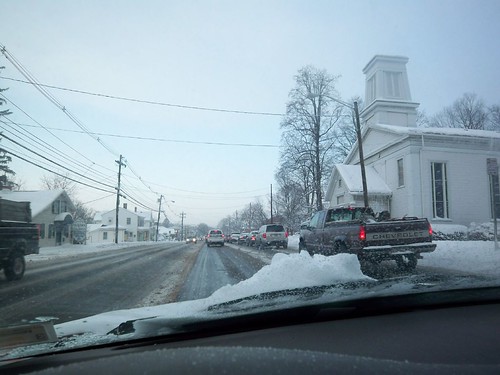
As I’m not ready with the next part of my analysis of the YouTube/LiveVideo tempest-in-a-teapot, I’m sharing something completely different: my commute to RIT. Winter has come to Rochester. Today it was 11 degrees (Fahrenheit) out when I left the house. Over the last few days we’ve been getting a lot of snow. I’m not quite sure what possessed me, but I decided to (carefully) document my drive to work. So from time to time I would rest my digital camera on the steering wheel and take a photo.

As an experiment, I’ve taken all of these pictures, placed them on flickr and geotagged them. The result, you can track my commute. The location of the photos are pretty much dead on. In fact, the act of placing them was really interesting in and of itself. Doing so caused me to relate to my picture, my commute, and the locations I pass by in a very different way.

What’s your commute look like?

Here’s the first picture, 12 more follow after the jump.

Winters Day 2: Driving to Work - Approaching 4 corners in Penfield

Read the rest of this entry »

YouTube.com versus LiveVideo.com

The story of similar services vying for the same audience isn’t anything new. What makes this an interesting thread to watch is that as the contenders here are both social computing sites, part of the audience they are competing for are also their primary content creators. The result is a war not just of companies, but rather of self made “celebrities.”

I stumbled across this during my citizen journalist research on YouTube and it sucked me in. The breakdown goes something like this:

  • 2006? – LiveVideo.com comes online
    For the life of me I can’t find a date for this. But I know it happens sometime before October.
  • Oct 9, 2006 Google Acquires YouTube
    The google linkage is will come up numerous times in the arguments that follow.
  • Oct 25, 2006 – Smosh launches a LiveVideo channel
    Smosh, a pair of 19 years olds, were one of the YouTube’s better known successes. The rational behind their move, and the re-branding of their videos as “Powered by LiveVideo.com” will eventually be called into question.
  • Nov 2006 – ~Jan 1, 2007 – relative quietv
  • ~Jan 1 – 20, 2007 – Flurry of activity – Investigation and Migration
    During this period a number of YouTube members post videos reviewing the LiveVideo service. Some announce, via YouTube, that they are setting up duel accounts. A number of prominent YouTube community members1 migrate to LiveVideo entirely.
  • Jan 20, 2007 –Renetto v-blogs “Traitors or Not.. Smosh, Geriatric1927, Boh3m3, DIGITILsOuL?
    Paul Renetto, a well known YouTube v-blogger, attacks Smosh and others YouTube members who have established LiveVideo accounts. He alledges that a number of them were paid by LiveVideo to jump ship and refers to them as traitors.
  • Jan 20 – 23, 2007 – Explosive Response
    Youtube an LiveVideo explode with feedback. On YouTube the video generates 170 response videos. At LiveVideo there are at least 77 responses posted.
  • Jan 23, 2007 -Renetto follows up with “Are you all being duped by a “Corporate Marketing Scam”?
    Renetto responds to the controversy his first post generated. By his account, the majority of feedback he got was negative. Three major points come out of this video:

    1. In October, he was approached by LiveVideo to migrate. He claims that LiveVideo offered to pay him to make the move.
    2. YouTube has paid Renetto, and other members, at least twice for videos. Once for the YouTube Christmas Video, and again for the New Years Eve video.
    3. He was appraochedby a talent agency who claimed that YouTube will be launching some form of revenue sharing program. This agency offered to represent him in artist negotiations with YouTube.

Since that time there has been a bit of back and forth postings. Renetto’s second post has generated at least 58 YouTube video responses so far. More responses are coming on LiveVideo. In the meantime, community members on both sites are posting videos rationalizing their decisions to stay, go, and in some cases remain neutral on these issues.

Ok, with all of that set up, tomorrow (or soon there after) I’m going to dive into the metapragmatics of this exchange as a there’s a lot of “culture” happening as I type.

1 – The list of users will eventually make it up here.

In answer to the question “why all this musing on campaign videos?”, if all goes as planned, I start my PhD studies in the fall. Provided I go the anthro route, I’ll be looking at citizen journalism and American politics. Internet video broadly, and YouTube specifically, play an important role in that mix.

Honestly, the more I begin to explore YouTube, the more complicated things get. It’s a mish mash. And the threads that are emerging from it are so varied I’m not quite sure where to start. All of it complicates this question of what exactly a citizen journalist is. There’s a lot of citizen commentators and folks who post clips from news networks. And activists.

I’m just not quite sure about “journalists.”

On Saturday, Hillary Clinton became the latest democrat to use an Internet video to announce their presidential intentions. There are a couple interesting points about her video. One is how well timed to “news rhythms” it was. By releasing on a Saturday morning, her camp effectively ensured it would just make Sunday newspapers, many of which go to press early that afternoon. The net result there was that the video was the first thing discussed both in papers and on the Sunday news programs (trumping the Obama video released earlier in the week).

Another things to note is the cinematic quality of the video — by that I mean how it employs the tools and conventions of movie making. Where the Obama video was a stationary, single take, the Clinton video features at least three cuts and the camera is constantly moving (arguably to the point of distraction).

The Clinton camp also choose to host the video themselves, at HillaryClinton.com. Unlike the Edwards and Obama videos, Internet users cannot aggregate the Clinton video through embedded links. Instead, Clinton’s team’s choice to provide a high resolution Quicktime version of the video for download seems a bit of a strange choice.

The benefit to her competitor’s distribution choices was that they allowed anyone to publish their videos through the use of the <embed> tag. There was no need to worry about the overhead of asking everyone to host a 55 mb or assuming that most bloggers have the technical skill to place that file on their website. More importantly, with the aggregation model, everyone is referring back to a single, master video. Which means that if Edwards or Obama chose to update the content, those changes would immediately be reflected across all sites.

The result of Clinton’s distribution choice can be seen in two ways on YouTube. First, The Hillary Clinton For President Committee, a grassroots organization supporting Clinton’s run, encouraged people to link their blogs to a YouTube video of CNN’s replay of Clinton’s video instead of the original artifact. The second is that people are already mashing-up the original high def source video the Clinton camp provided to make anti-Hillary videos.


On a side note, I think my favorite YouTube Obama v. Clinton video is this one. It’s simple and goofy — a person called up both of the candidate’s websites and played the videos against each other.

Reference:

Bernius, M. (2007) a tale of two candidate???s video distribution strategies
101_0116

Just a quickie… I tried out the Kodak Easyshare V705’s panorama tool. Man, my former employer really nailed this one. I’ve been very impressed with the camera – both in terms of lens technology and the user interface itself. It’s great to see Kodak continuing to live up to its boo-yah, non grab-ass vision outlined earlier this year:

[youtube]Sz6XjXu-oT8[/youtube]

That’s about it. I’m currently closing a karma circle and writing a letter of recommendation for an excellent student who is hoping to get a summer internship at the NY Metropolitan Museum of Art.