Archives for category: praxis

I’ve started the process of pulling together my application packet for the full time position at the School of Print Media. For those not familiar with it, the academic application process differs in a number of ways from that of other jobs. Instead of a resume, I will be submitting my curriculum vitae (cv), a detailed account of my academic and professional history. I am also expected to submit two statements, essays that present my research interests and teaching philosophy. Each statement shouldn’t go much more than a page.

Right now, I’m deep into planning them out. I’ve been filling pages with notes about my personal beliefs on teaching and research. The latter, research, has been progressing far more smoothly. It hasn’t taken much time to refocus my media anthropology interests on the world of print and new media. Heck, it was pretty much there already; just replace sex-bots with Gutenberg.

The teaching statement on the other hand is vexing me. This is supposed to be a deeply personal document that lays out who I am and what separates my approach from others, not to mention what will make my approach effective. In theory, this would have been developed over a few years of TAing. Unfortunately, I don’t have that luxury, and I’m a little concerned about that. But trust me, that little detail isn’t going to stop this process. For the moment, I’m reading the wealth of online information about teaching philosophy statements. I think I’ve got the structural formula down. The next step will be to put a first draft together. I’m trying to accomplish that by Friday.
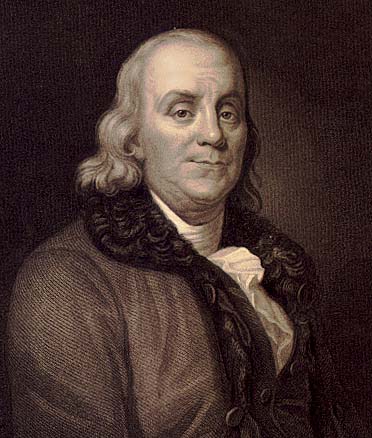
Ben Franklin
(January 17, 1706 – April 17, 1790)

“Tell me and I forget.
Teach me and I remember.
Involve me and I learn.”
– B. Franklin

One of the fondest memories from my time as an undergraduate at RIT was being singled out and favorably compared to Ben Franklin during a School of Printing Event. I don’t think I was deserving of the honor, but it meant a lot. Franklin and I will be getting to know each other better in the months to come. In the meantime, happy 300th birthday, oh Patron Saint of Printing. Were you alive today, you’d be blogging, and far more eloquently than most out there. Certainly more so than I.

I just got back from the second lecture that I’ve attended since starting here at RIT. As part of my preparations for next quarter, I am sitting in on the classes I’ll be teaching in spring. Tonight was a really valuable experience. I got to experience what happens when a “smart” classroom turns dumb. The overhead projector refused to acknowledge the existence of the instructor’s laptop. While the teacher eventually emerged victorious, the ensuing hot man-on-computer wrasslin’ match was a sobering demonstration of how quickly technology problems can disrupt a class. The incident was in stark contrast to classes at the University of Chicago, where dry-erase markers are looked upon as unproven technology compared to tried and true chalk.

From this incident I learned to make sure to arrive early and test the equipment. In the instructor’s defense, his planned pre-flight was stymied because the preceding class ran over, providing him no prep time. Thus a secondary lesson is to expect the unexpected.

Beyond projector issues, I learned that I have managed to retain a lot of the fundamental printing knowledge that was instilled in me over a decade ago within these brick lined walls. Professor Hoff, where ever you are, I just want to say thank you. This means that I can spend much more prep time structuring the material, as opposed to relearning it. That said, the structuring will be no easy task. The goal of this course is to present a solid and relevant overview of the various printing processes and the printing industry. There is a large amount of interconnected information in there and my first order of business is to decide what’s essential and what order it should come in. An interrelated challenge is to appropriately set subject “depth,” ensuring that I avoid going to shallow or making students take too many drinks from the fire-hose.

Needless to say, I’m excited about meeting these challenges. I’m beginning to see how I can make a difference and how a new perspective will be useful.

Last night, I attended my first lab class. It marked my return to a pressroom floor, though admittedly a very different type of one than those I knew in the past. The class was held in the Digital Print Lab at RIT’s Center for Integrated Manufacturing Studies (CIMS).

This is the Kodak NexPress, a digital press that can be used for variable data printing. Variable data printing is a term used to refer to print jobs where each impression (printed page) is unique. No two pages printed by the NexPress need necessarily be the same (though the NexPress is more than capable of accurately printing the same page over and over again).

One variable data application for the NexPress is printing custom, personalized mailers. And that was the focus of this particular lab. Students were printing out personalized postcards addressed to customers of a fictitious camera supply store. Next quarter I’ll be teaching this lab as part of a course on Variable Data Printing.

Side notes

  • The above lab is currently being taught by the man known to some of this blog’s readers as MoFo. Again, it’s a small, small, world.
  • The pictures from the last two days were taken with my new cell phone, the Motorola e815. I have yet to blog about it, but I cannot sing the praises of this phone highly enough. While not as drop dead sexy as the Razrs, it is pound for pound and buck for buck one of the best phones out there (and far better than the currently available Razrs, too).

Well, I’ve already slipped my “I’ll post every Monday thru Thursday” promise. Given my track record this should come as no surprise.

The last three days have been spent learning how much the School of Print Media (SPM) and RIT have changed since I graduated. This will most likely go on for a while. I attended my first faculty meeting and met most of the SPM staff. One of the things to file in the “it’s a small world” category is that my former upstairs neighbor, Dr. Franziska Frey, is now on the school’s staff. Interestingly, it was another upstairs neighbor from 195 Merriman St who unknowingly set this entire process in motion. I with hence forth refer to this pattern of serendipity as the “195 Effect.”

Today’s theme will be reading and research. Yesterday I raided the RIT Library and returned with a stack of books on the 15th century European evolution of print. I’m interested in learning a bit more about Messrs. J. Gutenberg and A. Manutius (both the Greater and the Younger).