Archives for posts with tag: RIT

I believe in the power of print media. I also believe in its longevity. Despite some futurist’s assertions, I do not think we are nearing a print or paperless future.[1] That said, I do not know if I believe in the viability of the Printing Industry as it currently exists. American Printer and industry experts tell us that we are in a time of transition. The question is:

What does the future of printing look like? What will be the next instantiation of the Print industry be? Are we rapidly approaching a time of new industries that use print, but are not necessarily printers?

What will follow in the days, weeks, and months to come is a meditation on these questions. I do not want to present what I write as a definite or final view of the future. These writing are simply a dialog with myself, with the industry as I observe it, and with anyone else who chooses to contribute to these posts. (Click on the More below for the full article)

Read the rest of this entry »

I have to confess to often being in complete awe of imaging technology. Joel Snyder, my photo theory professor at Chicago, once remarked that no matter how many times he’s seen it, he’s still amazed watching the latent image emerge on exposed photographic paper that is placed in developer. Having spent a bit of time in a darkroom, I understand that uncanny reaction.

I often experience a similar feeling when I watch a press at work. Such was the case when I stopped by RIT’s Printing Applications Lab today to watch a class project being run on the Goss Web Press. It’s strangely breathtaking to observe an image appear, color-by-color, on a web of paper flowing at breakneck speeds through a press. Faster than the eye can see, for this press operates at a speed of multiple feet per second, each layer of ink — black, cyan, magenta, yellow — is applied, in perfect registration, as the paper flows from tower to tower. The paper then disappears into a drying unit and then emerges and is immediately folded and cut.

The press itself is far to large for me to take a picture of. I did manage these two shots using my cellphone. The first is of the web passing out of the magenta tower (no relation to Stephen King’s famed Dark Tower). The second is of the end result — folded signatures — emerging from the press.

Photos of the Web Press

Today, while attending a New Media Perspectives lecture, I discovered that the view from the last row of Webb Auditorium at RIT provides a sobering lesson for the budding teacher. From my vantage point I watched as student after student opted out of the lecture with the help of portable electronics. The student immediately in front of me spent most of his time watching anime episodes on his video iPod (just as an aside, I was totally blown away by it and want one). Ahead of him was another student hiding a Playstation Portable (PSP) behind his notebook (the oldest trick in the book). Around the classroom multiple students were checking e-mail and traversing the web on their laptops. In the interests of full disclosure, I have to cop to doing this once or twice while at the U of C. But I never spent an entire class alternating between playing Quake III and Madness Interactive, with an occasional break to watch Sealab:2021 episodes. A number of others resorted to using their cell phones to txt and play games.

I’m not sure how to react to this or take it into account in planning classes. The knee jerk extremes would be to either ban laptops (which is just plain dumb) or simply pretend that it shouldn’t happen (or even worse, won’t happen to me). I’m just not quite sure what the middle ground would be. Any thoughts about it?

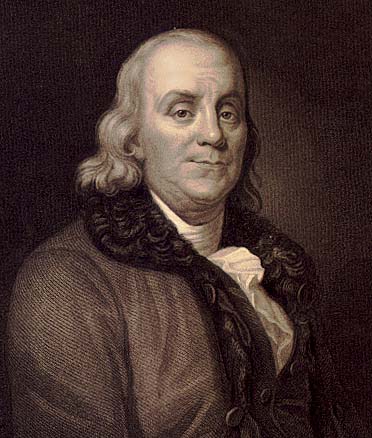
Ben Franklin
(January 17, 1706 – April 17, 1790)

“Tell me and I forget.
Teach me and I remember.
Involve me and I learn.”
– B. Franklin

One of the fondest memories from my time as an undergraduate at RIT was being singled out and favorably compared to Ben Franklin during a School of Printing Event. I don’t think I was deserving of the honor, but it meant a lot. Franklin and I will be getting to know each other better in the months to come. In the meantime, happy 300th birthday, oh Patron Saint of Printing. Were you alive today, you’d be blogging, and far more eloquently than most out there. Certainly more so than I.

Last night, I attended my first lab class. It marked my return to a pressroom floor, though admittedly a very different type of one than those I knew in the past. The class was held in the Digital Print Lab at RIT’s Center for Integrated Manufacturing Studies (CIMS).

This is the Kodak NexPress, a digital press that can be used for variable data printing. Variable data printing is a term used to refer to print jobs where each impression (printed page) is unique. No two pages printed by the NexPress need necessarily be the same (though the NexPress is more than capable of accurately printing the same page over and over again).

One variable data application for the NexPress is printing custom, personalized mailers. And that was the focus of this particular lab. Students were printing out personalized postcards addressed to customers of a fictitious camera supply store. Next quarter I’ll be teaching this lab as part of a course on Variable Data Printing.

Side notes

  • The above lab is currently being taught by the man known to some of this blog’s readers as MoFo. Again, it’s a small, small, world.
  • The pictures from the last two days were taken with my new cell phone, the Motorola e815. I have yet to blog about it, but I cannot sing the praises of this phone highly enough. While not as drop dead sexy as the Razrs, it is pound for pound and buck for buck one of the best phones out there (and far better than the currently available Razrs, too).